Interactive kiosks were once seen as a novel way to engage shoppers in-store. Placed near product displays or at entrances, these screens promised everything from personalised recommendations to easy ordering.
Yet many retailers have discovered that kiosks often become black boxes in the customer journey: they attract attention, but it’s hard to know whether they influence sales or simply create more digital clutter. This gap between expectation and reality is a major reason why digital signage projects fail. Without an ability to measure impressions, dwell time or conversion, screens often run generic loops of content that feel disconnected from the store’s actual performance. When they go blank or play irrelevant ads, they even damage brand trust.
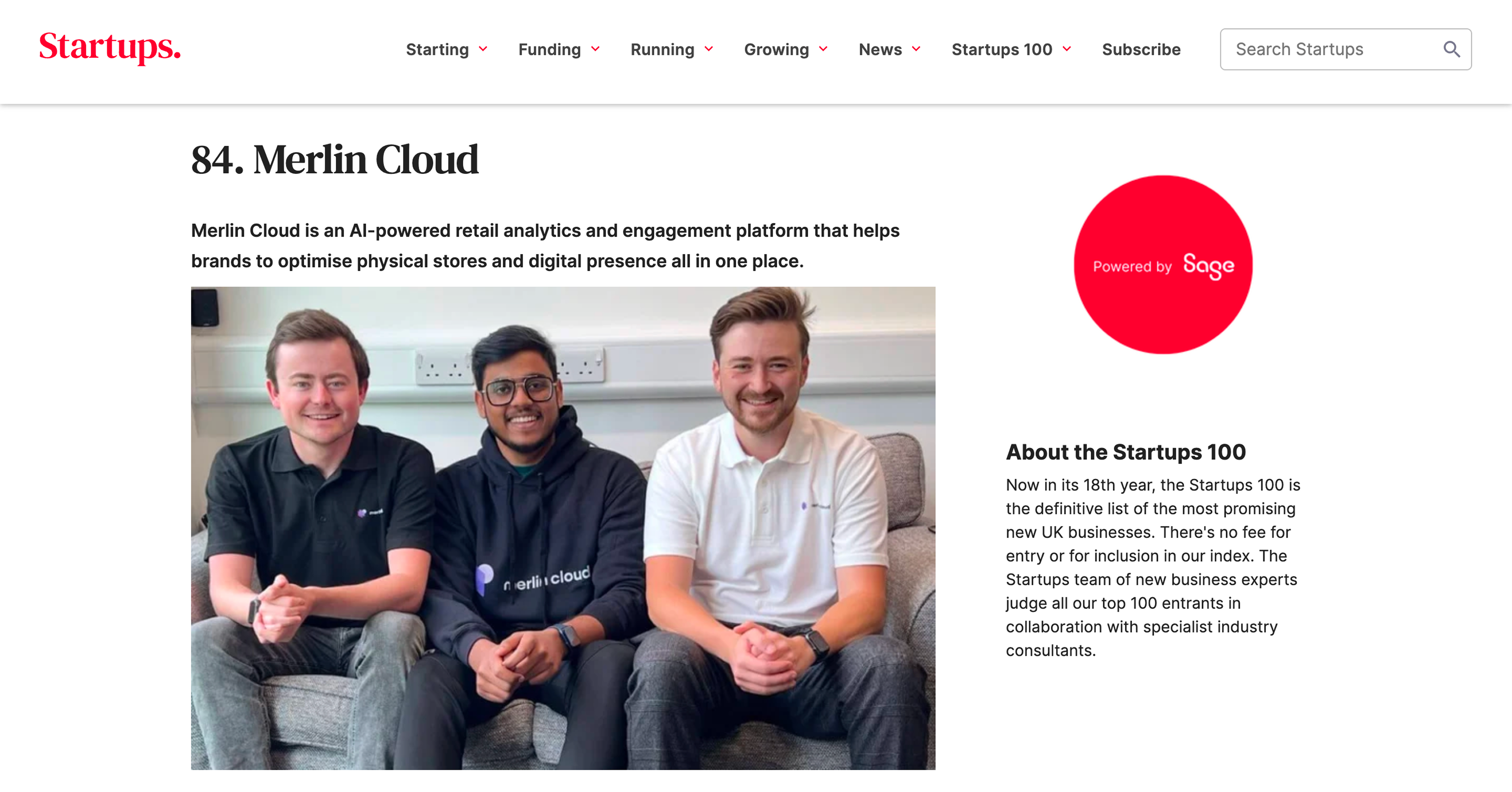
At Merlin Cloud we believe that physical technology must be judged by the same standards as e‑commerce: does it increase engagement, remove friction and drive revenue? Our listing in the Startups 100 2026 - the definitive index of the UK’s most promising new businesses - validates this approach.
Startups.co.uk notes that Merlin Cloud was founded to bring e‑commerce–level insight to physical stores, collating data from cameras, kiosks and QR codes into one AI‑powered dashboard.
The founders built modular licensing tiers and partnered with Samsung and Philips to demonstrate that data‑driven retail can deliver rapid ROI. Being named to the Top 100 is not just an accolade; it is a signal that the industry recognises physical retail as a digital asset and Merlin Cloud as the infrastructure layer enabling it.
The Promise and Problem of Interactive Kiosks
The appeal of interactive kiosks is clear. A screen that allows customers to browse catalogues, design products or sign up for loyalty programmes should theoretically shorten queues and increase basket size.
But too often retailers treat kiosks like static signage. Hardware is installed without a content strategy, and then left running the same slideshow across every store. Studies of digital signage deployments show that impressions, interaction rate, conversion rate, dwell time, sales lift and customer satisfaction are the core metrics that determine whether a screen drives performance. Yet only 32 % of marketers can measure these metrics across channels. Without the ability to measure, many screens devolve into decorative noise.
The challenge is heightened because kiosks sit at the intersection of physical presence and digital interaction. A customer might pause by a kiosk, touch the screen to explore products and then complete the purchase at a staffed checkout.
How do you connect those dots? How do you know whether the kiosk influenced the sale, or if the shopper walked away because of a slow interface? Traditional people counting at the entrance offers no answers, nor do click‑through metrics from the kiosk alone. Retailers need to link proximity data, interaction data and sales data into a single funnel, and that is the essence of the Kiosk‑to‑Cart concept.
Closing the Loop with Full‑Funnel Analytics
Merlin Cloud’s Kiosk Zones solve the black‑box problem by bringing together footfall analytics, interaction metrics and transaction outcomes. Camera‑based sensors detect when a person approaches the kiosk and measure dwell time - the number of seconds spent in front of the screen.
The kiosk itself records touch events, scroll depth and selections. The system then correlates this data with sales records to calculate conversion rates and sales lift. For example, if 100 shoppers view a “Design Your Own Trainer” kiosk, 40 interact, 10 add the product to their cart on the kiosk, and six complete the purchase at checkout, we know the funnel: impressions → interactions → conversions.
This full‑funnel visibility allows managers to see whether customers drop off at the interaction stage or if they abandon the purchase after interacting - just as e‑commerce teams optimise checkout flow.
Impressions and dwell time are only the start.
Merlin Cloud’s platform also measures interaction rate - the percentage of viewers who actively engage with the screen and conversion lift, the percentage increase in sales of products promoted on kiosks compared with stores without those kiosks.
When a campaign promotes a limited‑edition product, for example, we can see whether dwell times increase near the kiosk, whether the interaction rate rises, and whether sales of that product increase in the zone. Because the analytics tie back to point‑of‑sale data, retailers can experiment with different content sequences or promotions and know within hours which variation performs best.
Remote Store Campaigns: From Headquarters to Hundreds of Screens
Data alone is not enough; retailers also need the agility to change what’s on the screen. In 2026 the delay between a digital decision and physical execution is a major bottleneck. Marketing teams may craft beautiful campaigns, but by the time USB drives are mailed to stores, the promotion is already stale.
Merlin Cloud addresses this lag with remote store campaigns. Through the Locations dashboard, head office teams can deploy and update campaigns across 10 or 1,000 stores at once. Content is scheduled based on time of day, local weather or shopper demographics - for example, promoting seasonal specials during lunch hours or showcasing high‑end products when loyalty data indicates a surge in premium shoppers. Remote control also ensures that screens are never blank or broken because the system monitors uptime and sends alerts to maintenance teams.
Remote campaigns bring additional benefits. They reduce travel costs and labour hours for regional managers, who no longer need to physically visit stores to update content. Earlier research on remote store visits shows that remote auditing technology can cut audit‑related travel expenses by 30 % to 50 %. Instead of spending hours on the road, managers can analyse video clips and data from multiple stores in minutes, focusing on outliers rather than routine compliance. This shift from manual “surprise visits” to continuous digital presence is part of the broader move from reactive operations to proactive intelligence.
Retail Media Networks and the Kiosk Funnel
Interactive kiosks are not just sales tools; they are media assets. Brands investing in retail media want their ads to be seen at the point of decision, and they want proof that the spend is incremental.
The Kiosk‑to‑Cart model provides exactly that. With our measurement framework, retailers can sell advertising slots on kiosks and report on impressions, dwell time and conversion lift with the same rigour as online ads. For context, the digital signage industry identifies impressions, interaction rate, conversion rate, dwell time, sales lift and customer satisfaction as the six metrics that matter. When a brand sees that its ad on a kiosk increases dwell time by 20 % and lifts category sales by 8 %, they have evidence to justify further investment.
This measurement capability is increasingly important as retail media networks grow. Global retail media ad revenue exceeded $125 billion in 2023 and is expected to keep rising as brands look for new ways to reach shoppers at the “moment of truth”. Yet industry reports reveal that fewer than 30 % of retailers can currently measure the impact of in‑store media campaigns.
Merlin Cloud fills that gap by turning each kiosk into a data‑rich advertising unit. Advertisers gain third‑party verified metrics; retailers gain a high‑margin revenue stream that monetises physical space. Because campaigns are delivered remotely, they can be targeted, A/B tested and turned off instantly if they don’t perform.
Unifying Offline and Online Identities
Another power of the Kiosk‑to‑Cart model is its ability to bridge identity across channels. When a shopper scans a QR code or taps a loyalty card at a kiosk, the system can link that interaction to their online profile.
Today, brands often know more about a web visitor who spends two minutes on their site than a person who spends 30 minutes in their flagship store. By unifying these profiles, Merlin Cloud enables personalised recommendations and rewards to follow the customer from kiosk to mobile app and vice versa.
For example, a customer who designs a product on a kiosk can receive a reminder email with their saved design, or a push notification prompting them to complete the purchase. This unified identity is the cornerstone of modern loyalty and membership programmes.
Startups 100 and the Journey Ahead
Merlin Cloud’s inclusion in the Startups 100 2026 index is more than a badge - it is validation of the infrastructure approach we have taken to physical retail. The ranking describes us as an AI‑powered retail analytics and engagement platform that optimises physical stores and digital presence in one place. It notes how the company collates data from cameras, kiosks and QR codes into a single dashboard to give retailers live insights into customer flow and engagement.
It also highlights our focus on modular licensing and partnerships with technology leaders like Samsung and Philips to prove ROI. In a crowded market of point solutions, being recognised by independent judges underscores our differentiation: we are not a security company, a signage provider or a data reseller. We are the orchestration layer that turns physical spaces into intelligent, revenue‑generating assets.
The Startups 100 accolade also positions us as a trusted partner for enterprise decision‑makers. As boards and investors scrutinise technology budgets, recognition from a respected index signals that Merlin Cloud is a stable, scalable solution worth investing in. It provides social proof when pitching to new clients and recruiting top talent. Most importantly, it reinforces our mission to help retailers thrive in the dual reality of 2026 - where AI agents may shop on our behalf and human shoppers still crave experiential, personal encounters.
From Black Box to Strategic Engine
Interactive kiosks and digital signage will not deliver ROI simply by existing. Without measurement and control, they become black boxes that detract from the shopping experience and drain marketing budgets.
The Kiosk‑to‑Cart approach closes this loop by linking footfall, engagement and sales into a single funnel. Remote store campaigns extend this intelligence across entire estates, allowing retailers to deploy, test and optimise content at the speed of culture. When combined with unified identity and retail media monetisation, kiosks become strategic engines rather than decorative screens.
As a Startups 100 company, Merlin Cloud is proud to lead this transformation. We see the future of retail not as a battle between online and offline, but as a convergence where physical spaces are dynamic, data‑driven and deeply connected to digital journeys. By turning kiosks into measurable media assets and giving head offices the tools to act remotely, we help retailers reclaim the 5.5 % of sales lost to in‑store inefficiencies, unlock new revenue streams, and delight customers at every touchpoint. The loop from kiosk to cart is no longer a mystery - it is an opportunity waiting to be captured.