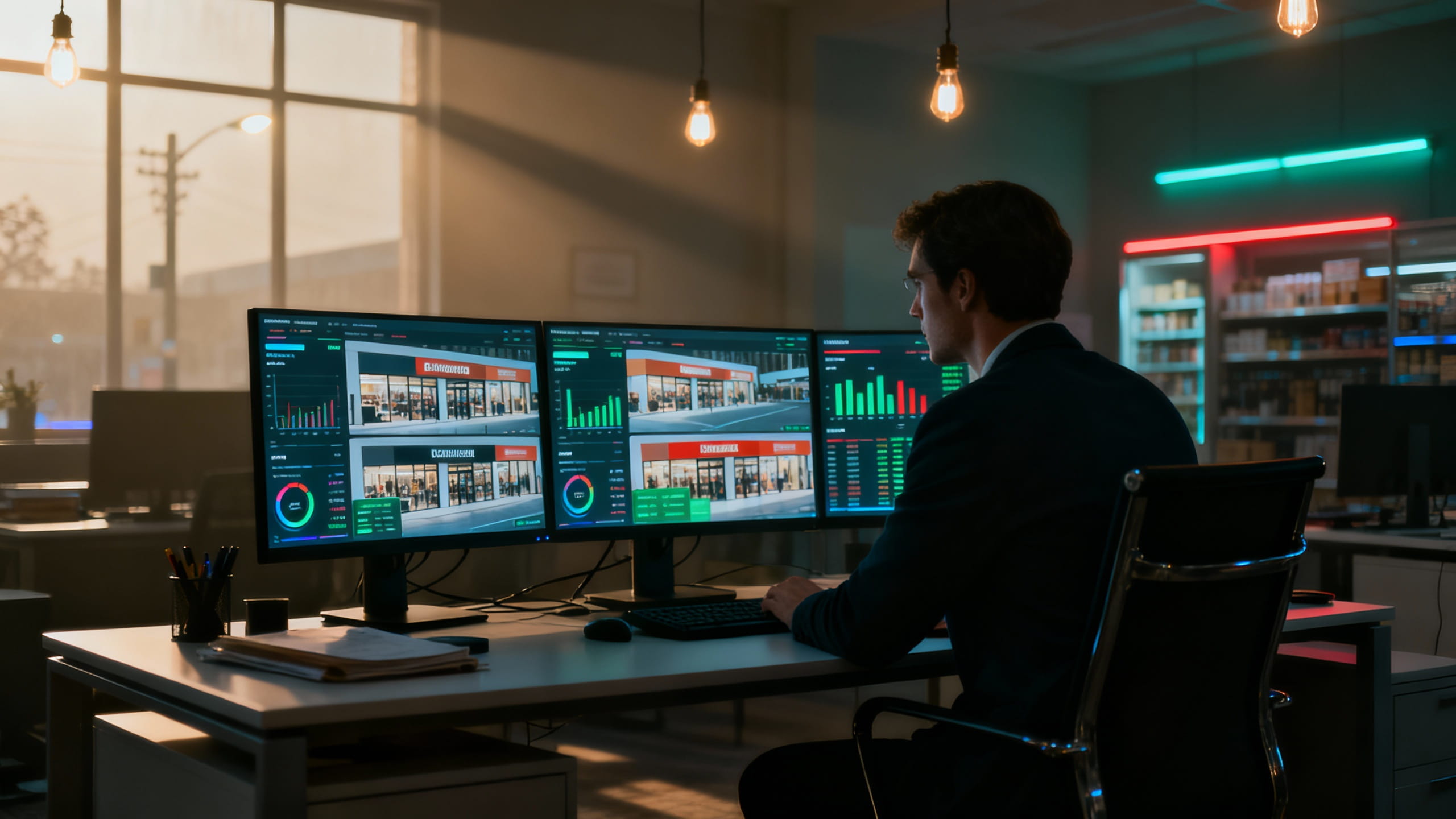
The Virtual Store Walk: Mastering Remote Operations in 2026
Imagine it’s Monday morning. Your email notifications are blinking, and you’re responsible for fifty stores spread across the country. You have time to visit only one in person, and you know the other forty‑nine may face issues you’ll never see until a complaint or a poor sales report lands on your desk. This is the “blind spot” that keeps regional managers up at night - and it’s exactly what the Virtual Store Walk eliminates.
In 2026, store leaders no longer have to rely on occasional site visits, phone calls or spreadsheets to understand how their locations are performing. Digital tools now offer a real‑time, always‑on view of each store’s operations and rather than “spying,” remote store control offers a digital presence that lets managers and executives see what matters and act when it counts.
This article explores how forward‑thinking businesses can run fifty locations from one desk, the features enabling this shift and the measurable impact on revenue and culture.
The Monday Morning Blind Spot
Before modern analytics, field teams spent hours driving between stores, compiling checklists and piecing together anecdotal feedback. Physical visits are expensive and inefficient. A blog by YOOBIC points out that travel and fuel costs involved in store visits and audits often don’t drive performance and that remote store visits dramatically reduce these costs. When area managers are freed from traffic and travel, they can devote their time to coaching teams and fixing issues.
Beyond cost, time is limited. Visiting a handful of stores gives an incomplete picture. Nick Nast from a major retailer captured this frustration after switching to a digital solution: he used to drive around Dallas - Fort Worth visiting every store, but after implementing StoreSight he “can just sit at home and do it”.
Digital store walks provide near‑real‑time insight across multiple locations - an unfiltered, time‑stamped view of in‑store conditions.
Instead of relying on spreadsheets and phone calls, managers can see shelves, displays and queues as they actually are.
There is also an observer effect in retail: stores look clean and organised when a manager is on site. Staff scramble to tidy displays, and the manager never sees how customers truly experience the space. Video‐based remote access solves this problem by letting you peek into the past.
With Focal Systems’ Store Walk feature, leaders can visit any section of any store at any time and even “time travel” to see how a section looked throughout the day. This capability exposes real conditions and removes the performative layer of a scheduled audit.
Time Travel: Beating the Observer Effect
Consider a weekend when sales dipped unexpectedly. With a Virtual Store Walk, a regional manager can rewind the day and view exactly what happened in each location. Did queues stretch beyond capacity? Were promotional displays unattended?
A remote solution built into Merlin Cloud’s Locations dashboard lets you rewind video feeds from cloud‑based cameras and correlate footage with sales data. If dwell times spike near the fitting rooms while conversion drops, you can investigate whether a queue is forming or a staffing issue is causing frustration.
Heat maps enrich this retrospective view. A 2025 article from Retail Business Academy explains that heat maps for physical stores visualise customer movement, engagement and dwell time using colour‑coded overlays.
These maps are generated from technologies such as Wi‑Fi tracking, camera‑based systems and infrared sensors. By reviewing traffic heat maps, managers can identify high‑traffic zones and bottlenecks, optimise store layouts and deploy staff more effectively.
Dwell time heat maps highlight areas where customers linger; managers can evaluate merchandising effectiveness and adjust displays to increase engagement. Queue heat maps show where customers wait and help optimise queue design to reduce friction.
Time‑traveling through video, supported by heat maps, allows you to diagnose missed revenue rather than merely reporting on it. When a promotion underperforms, you can see whether the product zone was empty, the display was messy or a competitor’s item drew more attention. This level of granularity transforms hindsight into insight.
From Counting to Agentic Action
Remote visibility is powerful, but watching hours of footage is not. The next leap is agentic AI - autonomous, goal‑driven systems that plan, act and learn. McKinsey & Company describes agentic AI as intelligent agents that proactively scour performance data, flag potential issues and provide actionable recommendations before you ask. These agents can cleanse and reconcile fragmented data, generate and test scenarios at scale and automate workflows across functions.
For example, instead of manually checking occupancy counts, Merlin Cloud’s system can monitor footfall and send alerts when a store approaches capacity. People counting technology tracks visitors entering and moving through a space, turning raw footfall data into actionable insights about peak hours, dwell times and traffic flows.
Advanced systems, such as AI‑powered video counters, can achieve up to 99% accuracy. Real‑time occupancy monitoring helps adjust staffing and maintain safety.
Agentic AI can also transform a stream of video into a workflow. When an anomaly is detected - for example, occupancy exceeds a threshold or a display appears disorganised - the AI flags the issue and attaches a relevant clip. The manager receives a real‑time alert and, with one click, assigns a task to the store manager.
This shifts remote control from passive surveillance to active management. McKinsey notes that agentic AI allows merchants to reclaim up to 40 % of their time by offloading manual, repetitive tasks and focusing on strategy. Early adopters report significant revenue and margin lifts due to stronger assortment decisions and data‑backed bargaining.
Merlin Cloud’s platform integrates this paradigm. Rather than watching countless hours of video, managers see summarised alerts and recommended actions. A queue overflow triggers a notification with a snapshot; a messy product zone auto‑generates a task to restock or rearrange.
This agentic approach ensures that remote store control is not about watching more screens but about making smarter decisions at scale.
Standardising the Perfect Store
Messy or disorganised displays are not simply an aesthetic issue. A 2025 visual merchandising report by One Door and GlobalData found that mid‑market retailers lose about $54.1 billion annually due to poor visual merchandising.
Messy displays alone caused 31.8 million shoppers to abandon stores, costing retailers $6.6 billion in lost revenue. For a manager responsible for fifty locations, ensuring display consistency is both a revenue protection measure and a brand imperative.
Remote store control platforms enable standardisation across locations. Merlin Cloud’s Product Zones feature lets you capture images of a specific zone (for example, the denim wall) across multiple stores and compare them in a single interface. Heat maps and dwell analysis reveal whether customers engage with the display or pass by.
The Retail Business Academy highlights that heat maps help retailers identify “dead zones” and “hot zones,” improving layout and flow while enhancing customer experience. They also support A/B testing; by comparing heat maps before and after a merchandising change, you can objectively measure impact.
Product zone analysis turns layout compliance into a repeatable process. If a new promotion isn’t executed correctly, remote managers see it instantly and can send corrective guidance. Over time, this creates a “perfect store” blueprint that scales across the fleet, raising standards everywhere instead of relying on one exemplary location.
Queue Management and Occupancy: Beyond Counting
Queues are a silent killer of sales. Research cited by Retail Customer Experience shows that 1.6 % of customers leave the checkout queue - and the store - without completing a purchase. For a retailer with 500 stores, that could equate to more than $50 million in lost revenue per year. Properly designed checkout queues can reduce customer wait times by 25 % and cut walk‑aways by as much as 90 %. Another study notes that about 70 % of people who abandon a queue are much less likely to return.
Remote queue monitoring blends video analytics with heat maps to flag when lines become too long. People counting data enables managers to open additional checkouts precisely when needed. Queue heat maps guide the design of single‑line or multi‑lane systems that move customers faster. With Merlin Cloud’s Queue Management module, you can respond proactively rather than reactively. By reducing wait times and preventing queue abandonment, you protect revenue and enhance customer satisfaction.
Occupancy monitoring is equally critical. In an environment where safety and experience matter, stores must avoid overcrowding. The Ariadne guide on people counting notes that real‑time occupancy monitoring ensures you never exceed capacity and that automated alerts notify managers when a building is nearing its occupancy threshold.
It also highlights that aligning staffing with actual foot traffic patterns improves customer service and labour cost savings. Real‑time occupancy data, integrated into the Virtual Store Walk, means you always know how busy each location is and can adjust staffing, promotions or store hours accordingly.
The ROI of Staying Home
Remote store control is not about laziness; it is about frequency and efficiency. Traditional store visits are time‑consuming and expensive. Remote operations reduce travel expenses and free field teams to focus on coaching and support.
Digital store walks provide real‑time, unfiltered views of store conditions, allowing managers to make decisions based on evidence rather than assumptions. They also enable more visits - you can “visit” ten stores in the time it takes to drive to one, ensuring consistent standards across your fleet.
The return on investment extends beyond cost savings.
By preventing messy displays, you avoid billions in lost sales. By optimising queue management, you recover revenue that would otherwise walk out the door. By monitoring occupancy and staffing, you improve customer experience and sales conversion.
By deploying agentic AI, you offload repetitive work and free managers to think strategically. Taken together, these benefits create a compelling case for staying home - and staying connected.
Bringing It All Together
Running fifty locations without leaving your desk may sound like a futuristic fantasy, but in 2026 it is a reality for retailers using the right tools. The Virtual Store Walk combines time‑traveling video, heat maps, people counting, queue management and agentic AI to deliver true remote store control.
It eliminates blind spots, exposes the real customer experience and enables timely, data‑driven action. It also builds a culture of accountability and continuous improvement by standardising the “perfect store” and empowering managers with actionable insights.
Merlin Cloud’s vision for smart spaces goes beyond security. Our Locations platform makes every store accessible from one screen. Product Zones turn visual merchandising into a science. Queue Management and occupancy analytics keep guests happy and safe. And our AI agents translate raw data into tasks that drive results. In a world where efficiency and experience are paramount, remote store control is not just an option; it is a competitive advantage.
Ready to see your entire retail empire from one screen? Visit our Locations product page to start your Virtual Store Walk today.