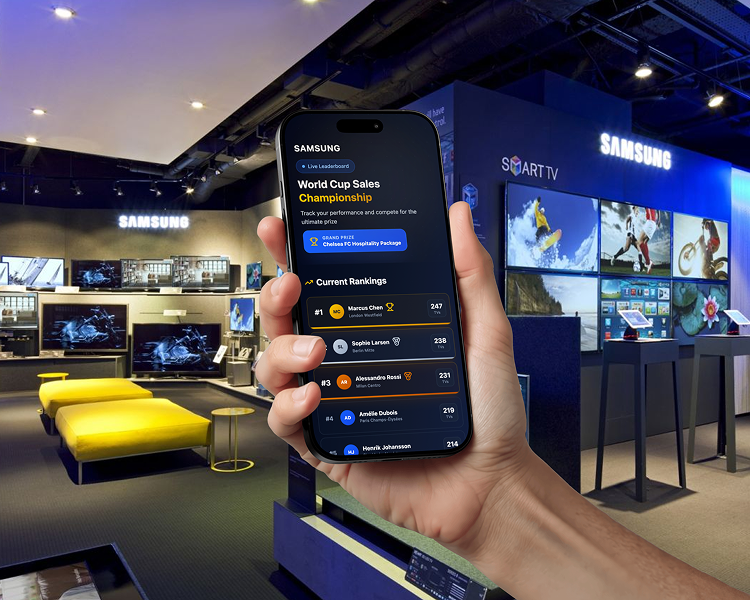
A screen that plays content asks nothing of the person walking past it. A game does. That distinction sounds small, but it's the difference between a kiosk people glance at and one they actually stop for. Two campaigns this year, one for a global electronics brand, one for an SME at a trade expo, both leaned on the same simple mechanic to prove the point, and both walked away with results worth breaking down.
Why passive screens struggle to hold attention
Most people have learned to filter out static in-store displays without consciously noticing them. A screen playing a loop of product shots or brand messaging competes with everything else pulling at attention on a shop floor or expo hall: other people, other stands, a phone in someone's pocket. It rarely wins.
A game changes the terms of that competition. It gives someone a reason to stop that has nothing to do with whether they're currently interested in buying, and it turns a passive walk-past into an active choice to participate. That shift from watching to doing is where the engagement actually starts.
What the research says about gamification and engagement
This isn't just a hunch borne out by a couple of good campaigns. A field experiment by Lopes et al. (2019) published in the Journal of Retailing and Consumer Services tested it directly: 378 participants at a major European sports retailer were split into two groups, one exposed to a gamified in-store activity, one doing the same activity without any game elements added. The gamified group showed measurably higher engagement, driven in large part by a genuine increase in enjoyment of the experience itself.
The finding matters because it isolates the variable. Same activity, same store, same participants pool, the only difference was whether a game layer was added. That's a stronger basis for the argument than anecdote alone, and it lines up closely with what both campaigns below actually delivered in practice.
Case study: Samsung World Cup Game
Samsung wanted to use World Cup excitement to pull customers into its stores and make TV browsing feel like an event rather than a transaction. The solution was a mobile-controlled penalty shootout, playable directly from a customer's phone on Samsung's own TV displays, with a leaderboard and a prize draw for an 85-inch Samsung OLED TV.
The campaign ran across 120 stores in 21 countries, supporting 15 languages as one connected experience. In store, it generated 4,399 games played, with the leaderboard turning individual plays into ongoing competition that kept people coming back to try and beat their score. The prize draw did double duty, converting gameplay into opted-in customer data for follow-up marketing, while the game itself guided players toward their local TV retailer to continue browsing.
The result: a 14% increase in TV sales across the campaign period, tied directly to a mechanic that had nothing to do with product specs or price and everything to do with giving people a reason to stop.
Case study: Sona Insurance
Sona Insurance faced a different problem entirely, one shared by most SMEs at a large trade show: how to stand out among hundreds of exhibitors competing for the same finite pool of attention. At Seawork Expo in Southampton, Sona turned its stand into a World Cup-themed penalty shootout using the same mechanic as the Samsung campaign, adapted for a B2B expo floor rather than a retail store.
Against 7,972 industry visitors attending the expo, the stand captured 163 qualified leads in two days. A daily prize, an official England shirt for the top scorer, drove repeat visits and kept the leaderboard competitive throughout the show. Every prize entry effectively became a qualified lead, and the conversations the game sparked led directly to Sona securing a major new marine insurance client.
What made both campaigns work
Different industries, different audiences, same underlying pattern. A few things held true across both:
A simple, familiar mechanic (a penalty shootout, in both cases) meant no explanation was needed. People understood the game instantly and could play in seconds.
A leaderboard turned a one-off interaction into something worth returning to, since beating a previous score is a stronger pull than playing once and walking away.
A meaningful prize gave people a genuine reason to hand over contact details, rather than lead capture feeling like a form to fill in.
The game was a means to an end in both cases, not the end itself. Samsung routed players toward local retailers, Sona used the conversation the game sparked to open a genuine sales discussion.
How kiosk engagement analytics turns play into measurable results
Neither campaign would mean much without the ability to actually measure what happened. Kiosk engagement analytics is what turned "people seemed to enjoy the game" into 4,399 tracked plays and a measurable sales uplift for Samsung, and into 163 individually captured leads for Sona.
That's the part that separates a gamified kiosk experience from a gimmick. Retail kiosk analytics built to track plays, leaderboard activity, and lead capture in real time means a campaign's performance is known while it's still running, not estimated afterwards from footfall guesswork. For a global brand running the same campaign across 21 countries, or an SME with two days to prove ROI on a single expo stand, that visibility is what makes the results defensible.
Applying this to your own campaign
Neither of these campaigns needed a from-scratch custom build. Both used the same core mechanic, adapted to a different brand and context, deployed through an interactive kiosk platform built to run and measure exactly this kind of activation.
The starting point is usually the same regardless of scale: pick a simple, quick-to-understand mechanic, give people a reason to come back (a leaderboard, a daily prize, friendly competition), and make sure whatever platform runs it can actually report back on what happened. Get those three right, and the specific game matters less than people might assume.
If it's worth talking through what a campaign like this could look like for your own stores or stand, get in touch with Merlin Cloud.
Related reading
See how interactive kiosks are built to run campaigns like these, explore retail analytics for how engagement gets measured in real time, or read the full Samsung World Cup Game and Sona Insurance case studies in full.