
Building a connected platform for retail compliance, field reporting and operational visibility at scale.
Meta's global retail operations relied on fragmented spreadsheets and manual reporting across markets, agencies and thousands of stores. A centralised platform transformed this into a structured field-governance system, connecting compliance, surveys, fixture data, issue reporting and analytics in one real-time environment.



Project impact
Survey turnaround, reduced from seven days, 99.8% faster.
Survey re-upload rate, down from 40.56%, a 94.5% reduction.
Stores in production worldwide.
Approach
Meta needed more than a new reporting tool. It needed a governed system capable of bringing together store activity, compliance data and field operations across a complex global retail network.
The objective was to replace fragmented, spreadsheet-led processes with a connected platform that made information accurate, searchable and immediately useful.
Store records, fixture information, policies, surveys, issues and supporting evidence were brought together within one structured environment, giving teams a consistent view across markets and retail partners.
Standardised survey journeys and validated bulk uploads replaced inconsistent manual reporting. Required fields, data validation and controlled workflows improved the quality of information at the point of capture.
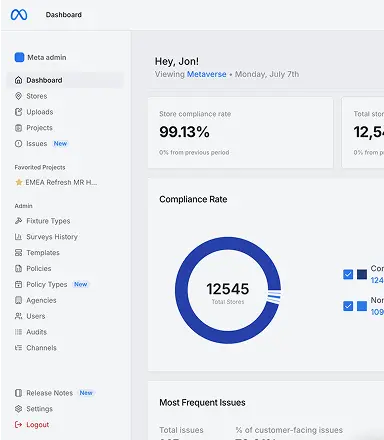
Live dashboards allowed Meta and its agency teams to monitor compliance, analyse activity and identify recurring issues by store, region or agency without waiting for reports to be manually compiled.
Role-based access, secure authentication, audit trails and structured permissions supported collaboration across Meta and agency teams while maintaining accountability and data integrity.
The result was a connected operational platform that reduced administrative effort, improved reporting confidence and helped teams move from retrospective reporting towards proactive retail management.
Insights
Reliable insight begins with structured data. Standardising how information is submitted significantly reduced rework and created a more dependable foundation for reporting across the retail network.
Real-time visibility also changed how teams could respond. Instead of waiting for spreadsheets to be consolidated, users could identify compliance risks, recurring fixture issues and regional trends while the information was still actionable.
Bringing surveys, stores, fixtures and issues into a shared data model created value beyond the original reporting process. Each submission contributed to a broader operational picture, making the platform increasingly useful as adoption grew.
This connected structure also creates opportunities for future automation, including AI-assisted survey forecasting, automated fixture recognition, planogram intelligence, predictive insights and more advanced issue workflows.
Performance
The platform transformed both the speed and reliability of Meta's field-reporting process.
Survey turnaround fell from seven days to 25 minutes, making completed information available 99.8% faster. The survey re-upload rate dropped from 40.56% to 2.25%, representing a 94.5% reduction in submissions requiring further work.
The platform now also supports more than 15,000 compliance and installation surveys.
Stores in production worldwide.
Active users across Meta and agency teams.
Structured survey data points captured.
Together, these improvements reduced manual correction, strengthened confidence in reporting and allowed teams to identify and respond to operational issues sooner.
Outcome
A fragmented, spreadsheet-led compliance process became a real-time field-governance platform, reducing survey turnaround from seven days to just 25 minutes.
Case Studies