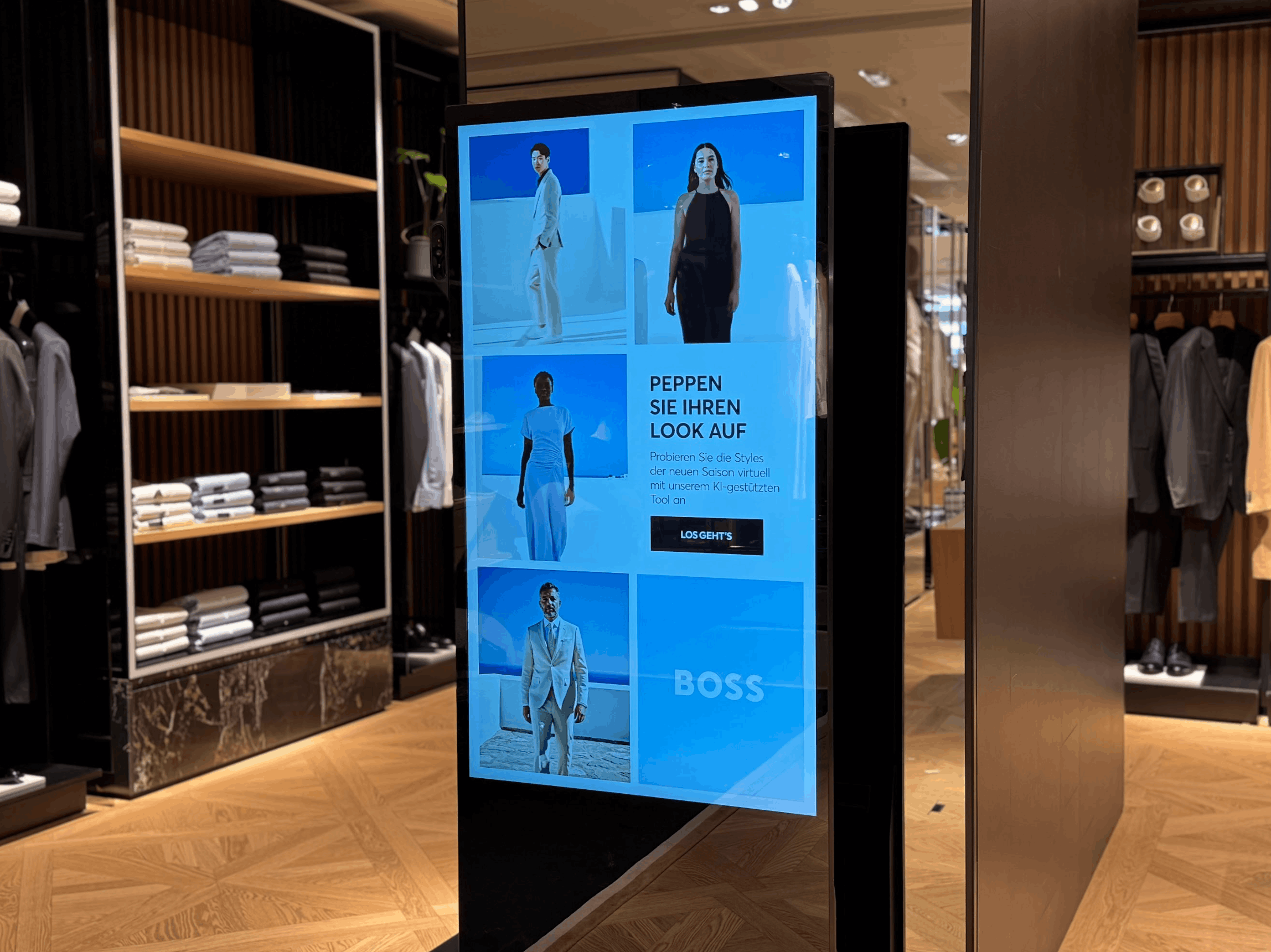
"Smart retail" gets thrown around so often it's started to mean everything and nothing. For some people it's AI-driven personalisation. For others it's smart shelves or self-checkout. All of that is technically accurate, but it also misses the shift that matters most for retail and marketing teams working the physical floor: stores aren't becoming smarter because of any single piece of hardware. They're becoming smarter because the technology in them is finally being asked to do something, rather than just sit there and display.
Here's what's actually driving that shift right now, and what's worth paying attention to first.
Why "smart retail" means more than a screen on a wall
Physical retail isn't going anywhere, whatever the ecommerce headlines suggest. Online and in-store shopping have settled into a genuinely blended pattern rather than a straight competition, with most shoppers moving between both depending on what they're buying and how quickly they want it. That's not a retreat from digital. It's a reminder that stores still carry real weight in the overall mix.
What's changed is the expectation placed on the technology inside those stores. A screen that just displays content used to be enough to look modern. It isn't anymore. Shoppers who move fluidly between digital and physical now expect the physical side to keep up, and that means in-store technology increasingly needs to do three things well: capture attention, prompt action, and report back something useful once it has.
That's the lens worth applying to every trend below. Not "is this new," but "does this actually change what happens in the store."
Campaign-led kiosks are replacing static displays
The most visible shift is away from screens that simply loop content and towards kiosks built around a specific, time-bound campaign. A competition, a quiz, a product discovery tool, a spin-to-win mechanic tied to a promotion. The difference isn't cosmetic. A campaign-led kiosk has a start date, an end date, a defined outcome it's meant to drive, and a way of measuring whether it did.
Retailers running seasonal activations, product launches, or brand partnerships are increasingly treating the in-store kiosk the same way they'd treat a digital campaign, with clear goals and a reporting layer behind it, rather than as passive signage that happens to be interactive.
Real-time analytics are replacing delayed reporting
Historic reporting, the kind that shows up in a monthly deck three weeks after a campaign ends, is losing ground to something more immediate. Retail kiosk analytics that update in real time let marketing and operations teams see what's working while a campaign is still live, not after it's already wrapped.
That matters practically. If one location is dramatically outperforming another, or a particular interaction is seeing high drop-off, a team working from real-time data can adjust mid-campaign. A team waiting on a monthly report finds out once it's already too late to do anything about it.
Interactive retail experience platforms are taking over from one-off builds
For years, an interactive in-store experience usually meant a bespoke build: agency-commissioned, expensive, and difficult to repeat. That's shifting towards interactive retail experience platforms that offer a library of proven experience formats (games, quizzes, product discovery tools) which can be configured and deployed quickly, with a custom build reserved for the moments that genuinely need one.
This isn't about lowering ambition. It's about not treating every campaign as a from-scratch development project when a well-built platform can deliver a tailored experience in a fraction of the time.
Multi-location deployment no longer needs a custom dev project
Retailers with more than a handful of stores have historically faced a difficult trade-off: build something bespoke and strong for one flagship location, or build something simpler that can actually be rolled out everywhere. Neither option was particularly satisfying.
What's changing is the ability to deploy a consistent, well-designed experience across dozens or hundreds of locations from a single platform, without a fresh development cycle for every rollout. That's less about cutting corners and more about treating deployment itself as infrastructure, something that should scale on its own rather than needing to be rebuilt every time the store count grows.
Put together, the four trends line up like this:
Trend | What it replaces | Why it matters |
Campaign-led kiosks | Looping static displays | Gives every screen a defined goal and a result |
Real-time analytics | Delayed monthly reporting | Lets teams adjust while a campaign is still live |
Experience platforms | One-off bespoke builds | Faster deployment without losing quality |
Multi-location rollout | Store-by-store custom projects | Consistent experience at scale, without rebuilding each time |
What this means for retail marketing teams in the next 12 months
None of these trends require ripping out existing infrastructure or committing to a lengthy transformation programme. They're mostly about raising the bar on what a screen or kiosk is expected to deliver, and being more deliberate about measuring it.
For a marketing or operations team planning the next 12 months, the practical starting point is usually the same question: is your current in-store technology set up to run a campaign and tell you how it performed, or is it still just playing content and hoping for the best? That answer tends to point fairly clearly towards what needs to change first. If it's worth talking through what that looks like for your own stores, get in touch with Merlin Cloud.
Related reading
See how retail analytics turns in-store activity into real-time reporting, explore how Meta built a connected retail intelligence platform at scale, or see the Samsung World Cup Game as an example of a campaign-led kiosk in action.