Point of sale materials, or POSM, have meant roughly the same thing for decades: posters, shelf talkers, dump bins, the physical props retailers use to catch attention and nudge a purchase at the moment it happens.
That definition hasn't gone away, but what actually counts as POSM is shifting fast, and a lot of retail marketing budgets are starting to reflect it.
What POSM actually means
POSM stands for point of sale materials. It is a core part of point-of-sale marketing, referring to the promotional tools retailers place in-store to influence a shopper right at the point where they're deciding whether to buy something. Posters, shelf edge strips, dump bins, window displays, all classic POSM.
Two related terms sit close to POSM and are worth being clear on. Point of purchase, or POP, refers specifically to the area where a shopper makes their decision, often before they've reached the till. Point of sale, or POS, refers to where the transaction itself completes, typically the checkout. POSM sits across both, it's the material used in either zone to influence behaviour.
Why the definition is expanding
For most of POSM's history, that's where the definition stopped: physical, printed, static. What's changed is that "material" no longer has to mean paper or plastic. A screen showing rotating content, a QR code linking to a digital experience, a touchscreen kiosk letting a shopper explore a range themselves, all of these are now doing the same job POSM has always done, just through a different medium.
Static POSM versus interactive activations
The practical difference between traditional POSM and an interactive retail activation isn't subtle once it's laid out side by side.
| Traditional POSM | Interactive retail activation |
Format | Printed, physical | Digital, screen or app-based |
Content | Fixed once installed | Updatable remotely, in real time |
Shopper role | Views | Participates |
Data captured | None | Engagement, preferences, contact details |
Lifespan | Reprinted for each campaign | Reconfigured for each campaign |
Neither approach is inherently wrong. A well-designed poster still does its job, and not every activation needs a screen. But the shift matters because interactive formats can do something static POSM structurally can't: capture what actually happened, who engaged, what they preferred, whether it led anywhere.
What this looks like in practice
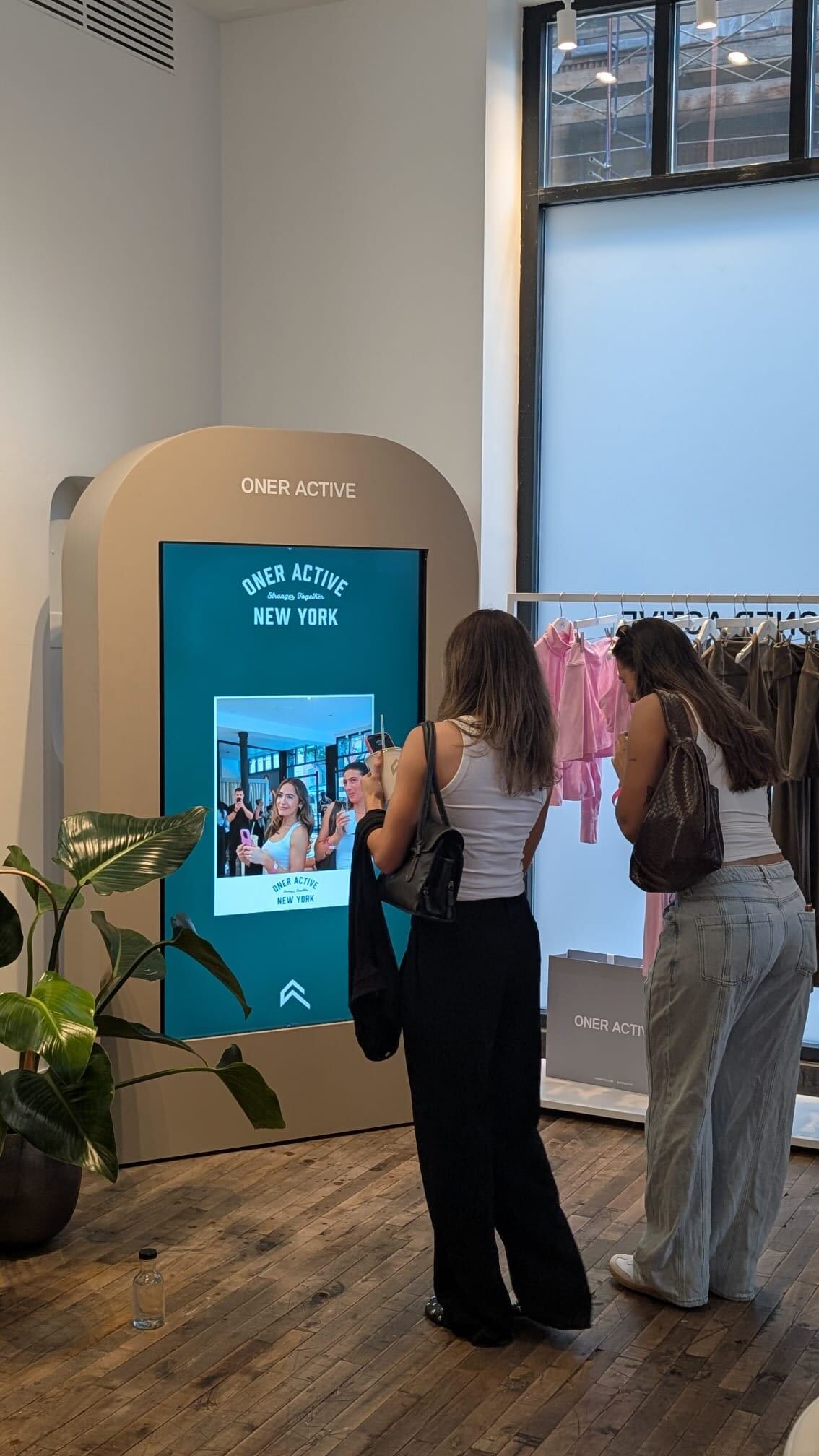
Oner Active's first New York pop-up is a useful example of where this is heading. Rather than relying on printed POSM to guide visitors through a temporary SoHo store, the four-day activation used two interactive formats built around the time of day.
During daytime hours, a Fashion Match tool lets visitors explore the new collection and put outfit combinations together themselves, turning product discovery into something personal rather than passive browsing. In the evening, the space shifted into a branded photo booth, giving guests a shareable moment to take away and post, extending the pop-up's reach well beyond the four days it physically existed.
Both formats did what POSM has always been meant to do, catch attention and support a purchase decision, but they also captured outfit preferences and contact details as part of the experience itself, turning a temporary activation into a source of first-party data the brand could act on afterwards. That's the genuinely new part. Static POSM couldn't have done that.
Why retailers are shifting activation budget this way
A few practical reasons are driving this beyond simple novelty.
Reusability
Campaign-specific printed displays are often single-use. Reprinting for the next campaign means new cost, new lead time, new waste. A screen or kiosk running an interactive experience can be reconfigured for the next campaign in far less time, often remotely.
Measurement
Traditional POSM offers no direct way to know whether it actually worked, beyond comparing sales before and after. Interactive formats can report engagement directly, how many people interacted, what they chose, whether they left contact details.
Relevance for pop-ups and short-term activations
Temporary retail moments, like Oner Active's SoHo pop-up, benefit particularly from formats that can flex across a few days of programming rather than committing to a single static message for the entire run.
Does this mean static POSM is going away?
Not entirely, and it would be a mistake to frame it that way. A poster, a shelf talker, a well-placed dump bin still does its job in plenty of contexts, and not every retail moment justifies the cost or complexity of an interactive setup.
What's actually happening is that POSM budgets are increasingly being split across both, with interactive formats taking on the moments where engagement, personalisation, or data capture genuinely add value, and static materials continuing to handle straightforward, high-volume messaging.
The practical question for most retail marketing teams isn't "should we replace POSM," it's "which parts of our activation would actually benefit from becoming interactive, and which don't need to."
If it's worth talking through where that line sits for your own retail activations, get in touch with Merlin Cloud.
Explore how interactive kiosks support formats like product discovery and photo booth experiences, or read the full Oner Active pop-up case study.