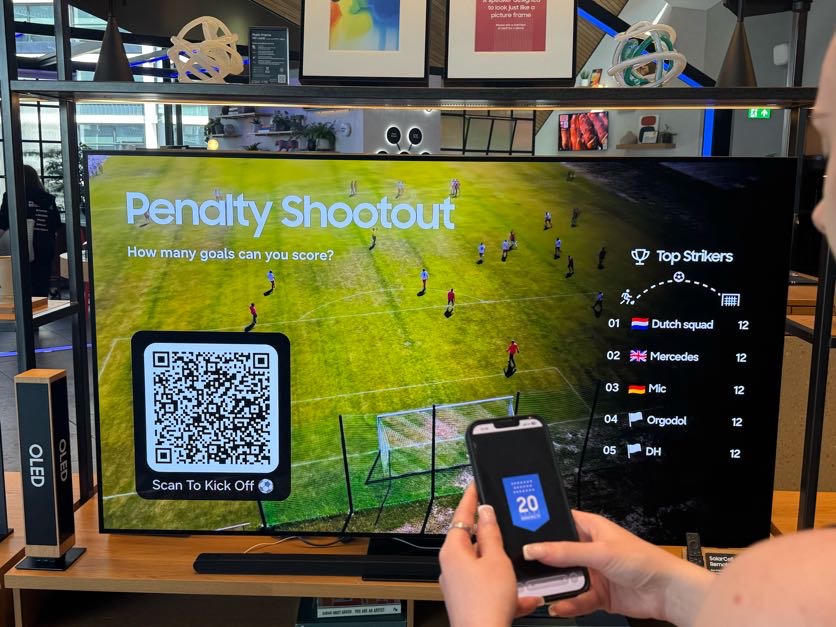
Booking the stand is the easy part of an exhibition, and the harder question is what will make people stop when they have a hall full of other stands to choose from. In 2025 the UK held 1,154 exhibitions, which between them brought together nearly 6.8 million visitors and 139,000 exhibitors, according to Oxford Economics analysis published by the Events Industry Alliance.
For any single stand, that means a short window of attention from someone who is already thinking about the next aisle. Of all the exhibition stand ideas teams consider, a short game is one of the few that gives a passer-by a reason to stop, and it can collect their contact details while they play.
This guide covers what makes exhibition stand games work, which formats suit which goals, and how one game at Seawork Expo produced 163 qualified leads in two days.
Why exhibition stand games give visitors a reason to stop
A screen that plays a video asks nothing of the person walking past, so it is easy to ignore. A game asks them to do something small and gives them something back, whether that is a score, a place on a leaderboard or the chance to win a prize. That exchange turns a passer-by into a participant, and a participant is usually easier for your team to start a conversation with than someone who has glanced at a banner.
Exhibition stand games also help with a practical problem, which is that stand staff cannot speak to everyone at once. While one visitor is talking to a colleague, the next can be playing, and the game can collect their details so that nobody walks away unrecorded.
What makes a good game for a trade show stand
The best trade show games share a few traits, and most of them come down to removing friction.
It can be understood from a distance, so a visitor in the aisle can see what is happening and work out how to join in.
It is quick enough to finish in a minute or two, so nobody feels they are committing to something long.
It offers a clear reason to play, such as a prize draw, a score to beat or a result worth seeing.
It collects contact details as part of playing, not through a separate form that interrupts the experience.
It shows a live leaderboard or a visible score, so onlookers can see that others are taking part and feel tempted to join.
A game that meets these conditions gives your team something easy to start a conversation with, which is a better opening than asking a stranger whether they would like a leaflet.
Which exhibition games suit which goal
Different formats suit different stands, and the choice usually depends on how busy the stand will be and what you want to learn about each visitor.
Game type | How it works | Suits |
Penalty shootout | A quick skill challenge with a score and a leaderboard | Drawing a crowd and encouraging repeat plays |
Prize wheel | A visitor spins for a chance of a reward | Fast, low-effort play for busy visitors |
Reflex test | A short test of speed with a score to beat | Quick turnover on a crowded stand |
Memory challenge | A matching or recall game | Visitors happy to spend a little longer |
Trivia and quizzes | Questions that lead to a tailored result | Learning about a visitor's interests while introducing your brand |
These are the ready-made formats on Merlin Cloud's games and competitions page, and custom mechanics are available on request. A quiz or brand challenge suits stands where you want to learn something about the visitor, because the results screen can respond to how they answered before it asks for their details.
How exhibition games handle event lead capture
Event lead capture usually means a badge scan, a business card or a form on a tablet, and each of those adds a step that busy visitors may skip. With a game, the contact details are collected as part of playing, for example through a prize draw entry tied to the game, so the visitor shares them in exchange for something they are already enjoying.
Quizzes work in a similar way, with a tailored results screen that prompts for contact details once the visitor has seen how they did, and the collected leads can be exported afterwards.
Whichever format you choose, visitors should be told how their details will be used, in line with UK data protection law, and any prize draw should have terms they can see.
An exhibition stand game at Seawork Expo
Sona Insurance exhibited at Seawork Expo in Southampton in summer 2026 and used a touchscreen kiosk running a World Cup-inspired penalty shootout game. Visitors played for a place on a live leaderboard, and entering a prize draw, with an England shirt as the daily prize, was how their contact details were collected. The leaderboard also encouraged people to come back and play again.
Over two days the stand captured 163 qualified leads and secured one major new marine client. Seawork Expo itself drew 7,972 industry visitors, which gives a sense of the crowd the stand was competing with for attention. The full write-up is on the Sona Insurance case study.
How to plan an interactive exhibition stand before the show
A game for an interactive exhibition stand starts with the outcome, so it helps to settle a few things before anyone briefs the artwork.
The goal, whether that is leads, booked conversations or footfall towards a particular product.
The prize and the entry terms, including how contact details will be used.
How staff will join in, for example who invites visitors to play and who follows up with players who leave their details.
The hardware and layout, so the screen can be seen from the aisle and there is room for onlookers.
The follow-up plan, so that leads captured on day one do not go cold after the show.
If you are planning an interactive exhibition stand for an upcoming show, the team at Merlin Cloud is happy to talk through game options and how lead capture would work for your stand. Most deployments start from a Merlin Cloud template, tailored to your brand, so the conversation usually begins with your goals and the show rather than a blank page. Get in touch to start that conversation.
Related reading
Browse the full range of games and competitions, read the Sona Insurance case study, or see how a quiz or brand challenge captures leads.