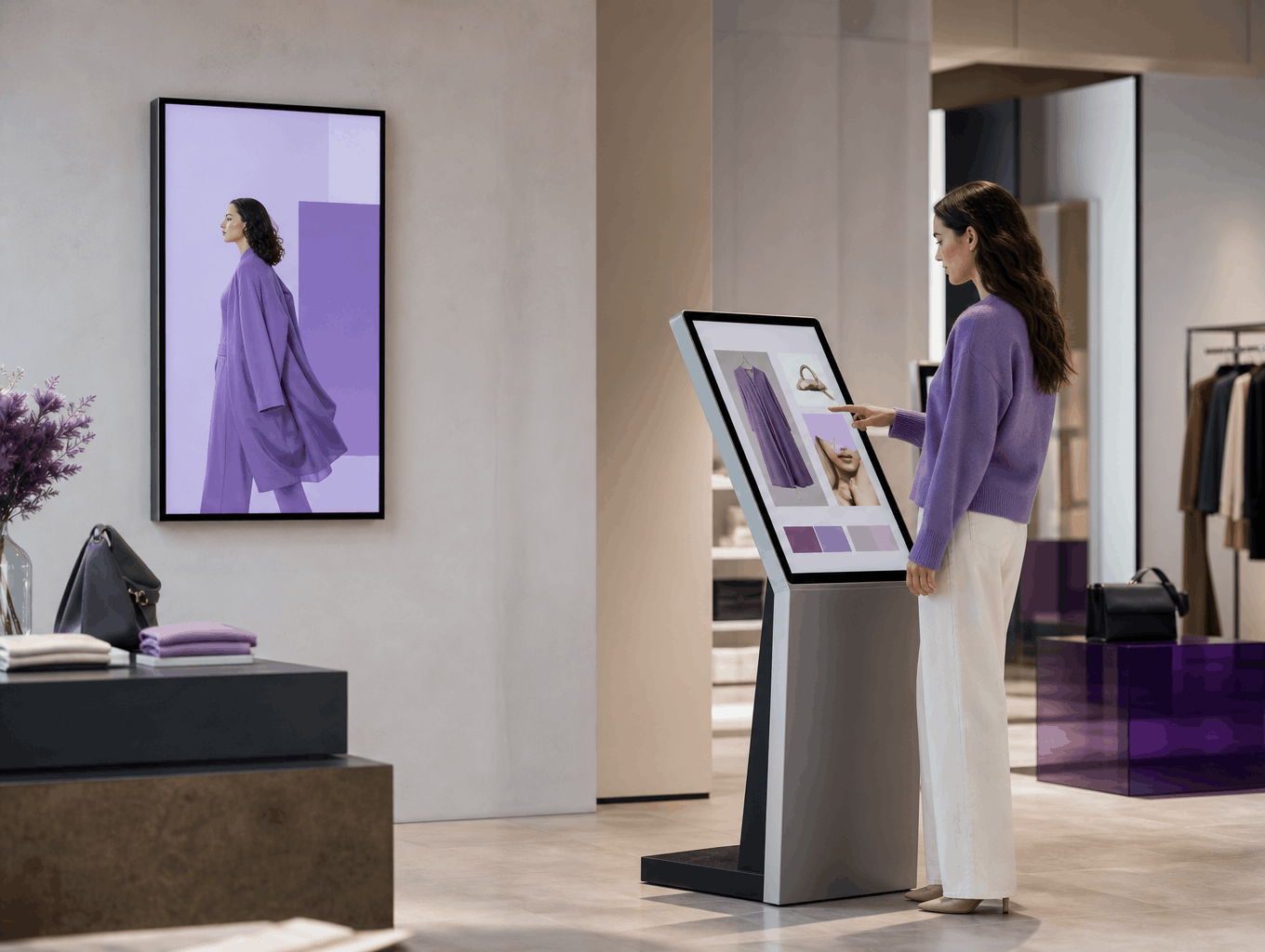
If you've spent any time researching in-store technology, you've probably seen "digital signage" and "interactive kiosk" used as if they mean the same thing but they don't.
Understanding where the two diverge matters more than it might seem, because choosing the wrong one usually doesn't show up as an outright failure. It shows up as a platform that technically works but never quite delivers what the business actually needs.
What is digital signage, actually?
Digital signage is, at its core, a screen that plays content. That content might be product promotions, brand videos, menu boards, or wayfinding graphics, and it's typically managed through a content management system that schedules what plays, where, and when. It's a one-way channel. The screen displays, and the shopper watches, or more often, walks past.
That's not a criticism. Digital signage does its job well for what it's designed to do, namely consistent, scheduled visual communication across multiple locations. Retailers have relied on it for years to standardise in-store messaging without needing someone to manually update every screen in every store.
A head office team can push new promotions to 200 locations at once, swap seasonal creative overnight, or vary content by region, all from a single dashboard. For that use case, it's a genuinely effective, low-friction tool.
The limitation shows up when a retail or marketing team wants more than display. If the goal is to get a shopper to actually do something, such as enter a competition, answer a quiz, scan a code, or explore a product range, a playback-only screen simply isn't built for that job. It can show the invitation to interact, but it can't run the interaction itself.
Where digital signage falls short for campaign-led retail
Most digital signage software is built around one core loop: schedule content, push it to screens, confirm it played. That's a solid foundation for passive communication, but it starts to break down against three things retail marketing teams increasingly need as their in-store strategy matures.
Interaction
A signage player can display a QR code, but it can't run the experience behind it, track who scanned it, or adapt what happens next based on shopper behaviour at the screen itself. Whatever interaction follows tends to happen on the shopper's own phone, disconnected from the screen that prompted it.
Measurement
Signage platforms can usually confirm a piece of content played, and for how long. They're not built to tell you how long someone actually engaged with it, what choices they made, or where in a journey they dropped off. That's a fundamentally different kind of data, and most signage tools were never designed to capture it.
Campaign structure
A retail campaign has a start date, an end date, entry rules, variations by location, and a result to report on at the end. Signage software isn't really built around that concept. It's built around content playback, not campaign lifecycle management.
None of this makes digital signage the wrong tool. It simply means it's answering a different question to "how do we run an interactive campaign in-store and know how it performed."
At a glance, the two categories break down like this:
| Digital signage | Interactive kiosk campaign |
Core function | Displays scheduled content | Runs a shopper-facing activation |
Shopper role | Watches | Participates |
Data captured | Content played, when, where | Entries, choices, completions, drop-off |
Structure | Ongoing content schedule | Defined campaign with start and end |
Best suited to | Brand messaging, menus, wayfinding | Competitions, quizzes, lead capture, product discovery |
What makes something an interactive kiosk campaign
Interactive kiosk campaigns start from the opposite direction. The shopper is meant to do something, not just see something. A game, a quiz, a spin-to-win mechanic, a product discovery tool, a lead capture form. The screen isn't the endpoint of the experience, it's the interface into it.
That shift changes what the underlying platform needs to do, and quite significantly. A kiosk campaign platform generally needs to:
Run and manage a defined campaign across dozens or hundreds of locations at once, with the same rules applying consistently everywhere
Capture what shoppers actually did at the kiosk in real time, not simply confirm the kiosk was powered on and displaying something
Report results back to a marketing team in a form they can act on, whether that's entries, completions, average engagement time, or which locations performed best
This sits closer to running a digital marketing campaign than to operating a display network, just executed on physical hardware in a physical retail environment. The mindset required to plan and manage it shifts too. It's less "what's on the screen this week" and more "what result is this campaign supposed to deliver, and how do we know if it did."
In-store campaign infrastructure: why the distinction matters operationally
The practical difference between the two shows up fastest at the moment something needs to scale or change. Updating what plays on a signage network across 50 stores is a content swap, usually handled centrally within minutes. Launching a new interactive campaign across those same 50 stores, with consistent rules, tracked entries, and centrally reported results, is an infrastructure problem rather than a content problem. It touches deployment, device reliability, data capture, and reporting all at once.
That's the gap in-store campaign infrastructure is meant to close. It's a platform built specifically to deploy, manage, and measure kiosk-based campaigns end to end, rather than a signage system with interactive features bolted on as an afterthought.
It's the difference between a network that displays what you tell it to, and a system that can actually run a campaign for you, handle the operational complexity underneath it, and hand back the results once it's done.
For retail and marketing teams, this distinction tends to surface at a specific, identifiable moment. It's the point where "we need this screen to do something and tell us what happened" stops being a nice-to-have and becomes a genuine project requirement, often triggered by a campaign brief that a signage platform simply can't fulfil.
Which one does your retail team actually need?
Choose digital signage if you need:
Consistent, scheduled visual communication across locations
A simple, cost-effective way to update messaging centrally
No requirement for shoppers to interact or for you to measure what they did
Choose an interactive kiosk campaign if you need:
Shoppers to actively participate, not just view content
Measurable engagement results, such as entries, completions, or drop-off
A defined campaign structure with a start, an end, and a result to report on
Many retail teams end up needing both, often from different tools, simply because they're solving genuinely different problems that happen to share the same physical screen.
Knowing which one you're actually asking for, before evaluating vendors, is the first step towards not ending up with a platform that looks right on paper but can't deliver the outcome the business actually needs.
Ready to see what a kiosk campaign could look like for your stores?
If you're weighing up whether your team needs signage or something built for interaction and results, it's worth talking it through. Get in touch with Merlin Cloud and we'll help you work out what fits.
Further reading
Take a closer look at how interactive kiosk campaigns work in practice, or explore campaign management to see how deployment, tracking, and reporting fit together end to end.