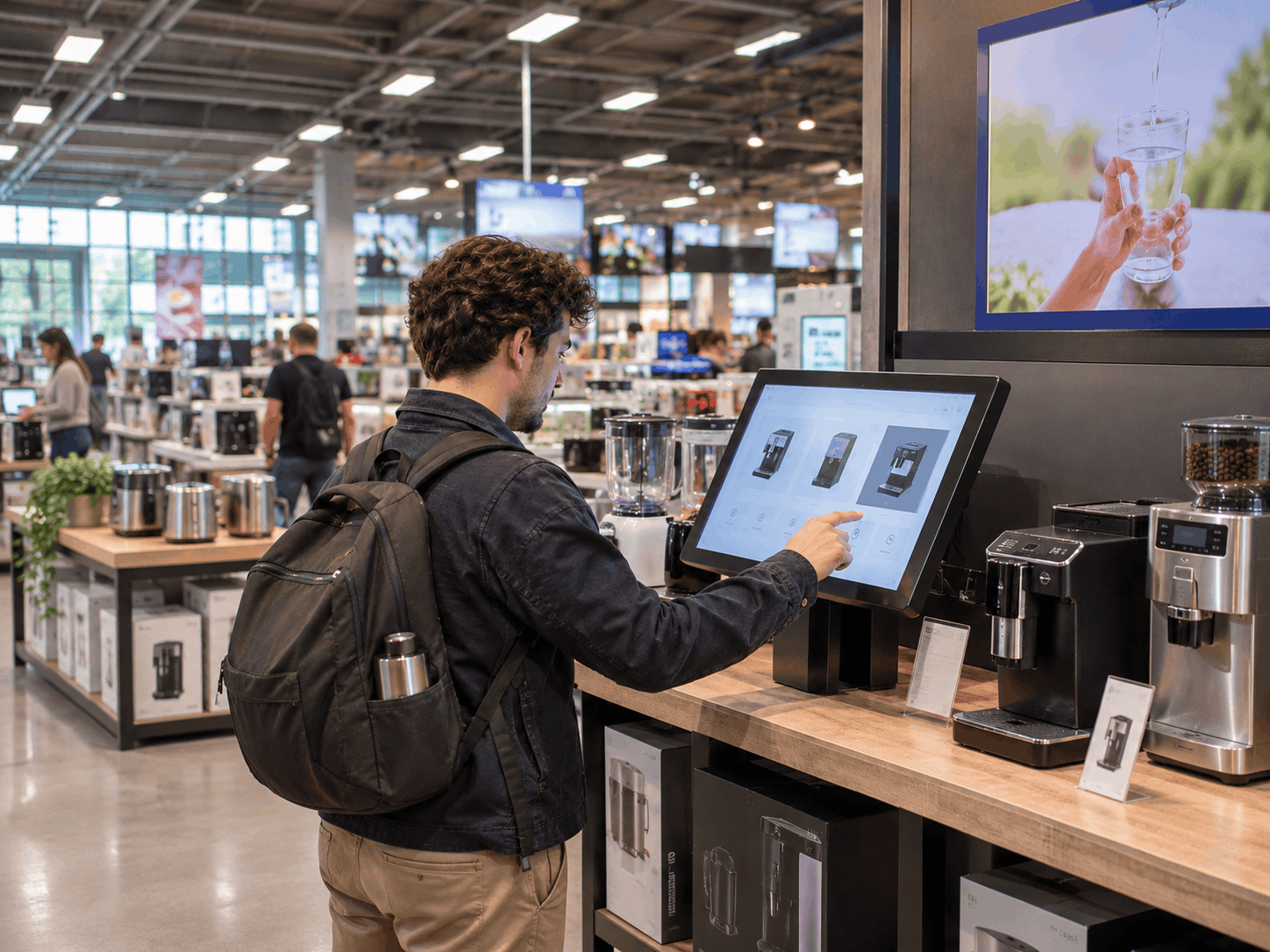
Shopper marketing influences buying decisions throughout the shopping journey, from online research to the point of purchase. In a shop, that can mean helping someone compare products, understand their options or discover something new through an interactive experience.
This guide explains what shopper marketing is, how it differs from other kinds of marketing, and where interactive in-store experiences such as touchscreens and kiosks fit, using two Philips store rollouts as worked examples.
What is shopper marketing?
Shopper marketing focuses on influencing buying decisions throughout the shopping journey, from consideration and online research through to the point of purchase. It includes retail media, promotions, product information, shelf displays, packaging, sampling and interactive screens.
The audience is someone actively shopping, rather than a consumer in the broadest sense. This guide concentrates on the in-store moments where brands can help people compare products and make a choice.
How is shopper marketing different from consumer marketing?
Consumer marketing builds broad awareness and brand preference through advertising, social media and content. Shopper marketing focuses on the decisions people make while choosing what to buy, whether they are researching online or standing in front of a shelf. A shopper who already likes a brand may still choose an alternative if it is easier to understand, so in-store marketing is about making the choice clear, relevant and easy.
A shopper who already likes a brand can still leave without it if another product is easier to understand, so in-store marketing is about making the choice clear, relevant and easy.
One thing that has changed is the tools. Printed displays can only say one thing to everyone, whereas an interactive screen can answer the question the shopper actually has. If you are looking at the print side of this, our guide to what POSM is and how it is changing covers it.
Where interactive retail experiences fit
An interactive retail experience gives the shopper something to do rather than something to look at. In practice this means a touchscreen or kiosk on the shop floor that responds to what the shopper chooses, such as a product discovery experience that lets them explore features, watch demonstrations and read reviews, or a game or competition that gives them a reason to stop.
Interactive retail displays of this kind are normally run as campaigns, with a start date, a goal and something to measure, so they fit naturally into a plan for influencing in-store decisions.
When configured with analytics, interactive displays can do two jobs at once: help shoppers make decisions and show brands which products and features attract the most attention. Merlin Cloud's interactive kiosks are built around that idea.
An example from Philips Personal Health
Philips Personal Health needed to stand out alongside established brands in competitive retail environments and give customers more reasons to engage with its products. With Merlin Cloud, it digitised 160 stores across 20 countries, installing more than 240 devices that ranged from interactive touchscreens to footfall cameras, with content localised and approved for each market.
The touchscreens let customers explore demonstrations, reviews, videos and detailed product information, while digital signage made products more prominent to passing shoppers. The case study reports that stores with advanced digital signage had four times more foot traffic than stores without it, and that the programme contributed to $165k in additional sales over three months. The full account is in the Philips Personal Health case study.
An example from Philips Domestic Appliances
Philips Domestic Appliances took a similar approach in urban stores across Europe, placing 45 interactive devices alongside headcount and footfall cameras. Shoppers could explore product details, reviews, videos and demonstrations on the touchscreens, and the team could see which products drew the most interest.
User interactions rose by 34% after deployment, and 145,000 people were tracked over six months. The case study also found that kiosks at the front of stores generated three times more interaction, which shows how much placement matters. That kind of finding is only available when the experience records what people do. Read more in the Philips Domestic Appliances case study.
How to measure shopper marketing in store
The measure that matters depends on the job the experience is doing. For product discovery, it might be how many shoppers use the screen and which products they explore. For a game or competition, it might be plays and opted-in entries. For layout and placement, footfall and dwell time show where attention is going, as they did for Philips. Our guide to what retail analytics software needs to get right covers how to choose and use that data.
Agree the measure before the campaign starts, so that results can be compared between stores and between campaigns. If the experience captures contact details or tracks movement through the store, tell shoppers plainly how the information will be used. The ICO's UK GDPR guidance and resources is the place to start.
How to plan an in-store programme
Start with the decision you want to influence, such as choosing between similar products or discovering a new range, and pick one experience that helps with it. Place it where shoppers will see it first, since the Philips Domestic Appliances results suggest that position changes how many people use it.
If you run more than a handful of stores, plan how the campaign will be scheduled and updated everywhere from one place, which is what campaign management is for. Finally, decide how you will review the results and what you will change in response.
How Merlin Cloud supports shopper marketing
Merlin Cloud runs interactive retail experiences for retailers and brands, from product discovery and games to quizzes and photo booths, on kiosks and touchscreens across a store network, and records how shoppers use them.
Most deployments start from a Merlin Cloud template tailored to your brand, so a conversation usually begins with the decision you want to influence and the stores involved rather than a blank page. If you would like to talk through what that could look like, get in touch.
Related reading
Read more about interactive kiosks, explore campaign management, or see how Philips used interactive retail in the Philips Personal Health case study.